Are We Still Beauvoir’s Women?
I have been thinking lately about the things women are asked to understand. To understand that people change. That desire changes. That someone can love you and still want someone else. That people make mistakes. That relationships are complicated. That nothing is black and white. That there is always the possibility for you to stay and settle, or not settle. Everyone cheats. People have no free will. With some of these things, I might agree. Or I did, up until today, I guess.
I keep wondering at what point understanding becomes another way of asking someone to put up with something. How many times have we been asked to understand the person who hurt us? He was confused. He was unhappy. He didn't know what he wanted. He needed something different. He couldnt help it. He still loved you. He just also wanted her. I have heard versions of these sentences before. I have lived inside some of them too.
I keep thinking about the female experience of desire. What it means to live on the receiving end of somebody else's. To be asked to understand it, accommodate it, forgive it, wait for it to settle. To somehow remain intact while somebody else figures out what they want.
I dont know how many times women have found themselves somewhere inside this story. Maybe more than we admit. I remember a woman in her 50s, whom I had met a couple of times, telling me that she had put up with her husband's desires when they were in their 20s, but now everything was okay. She was proud of staying. She kind of minimised what had happened.
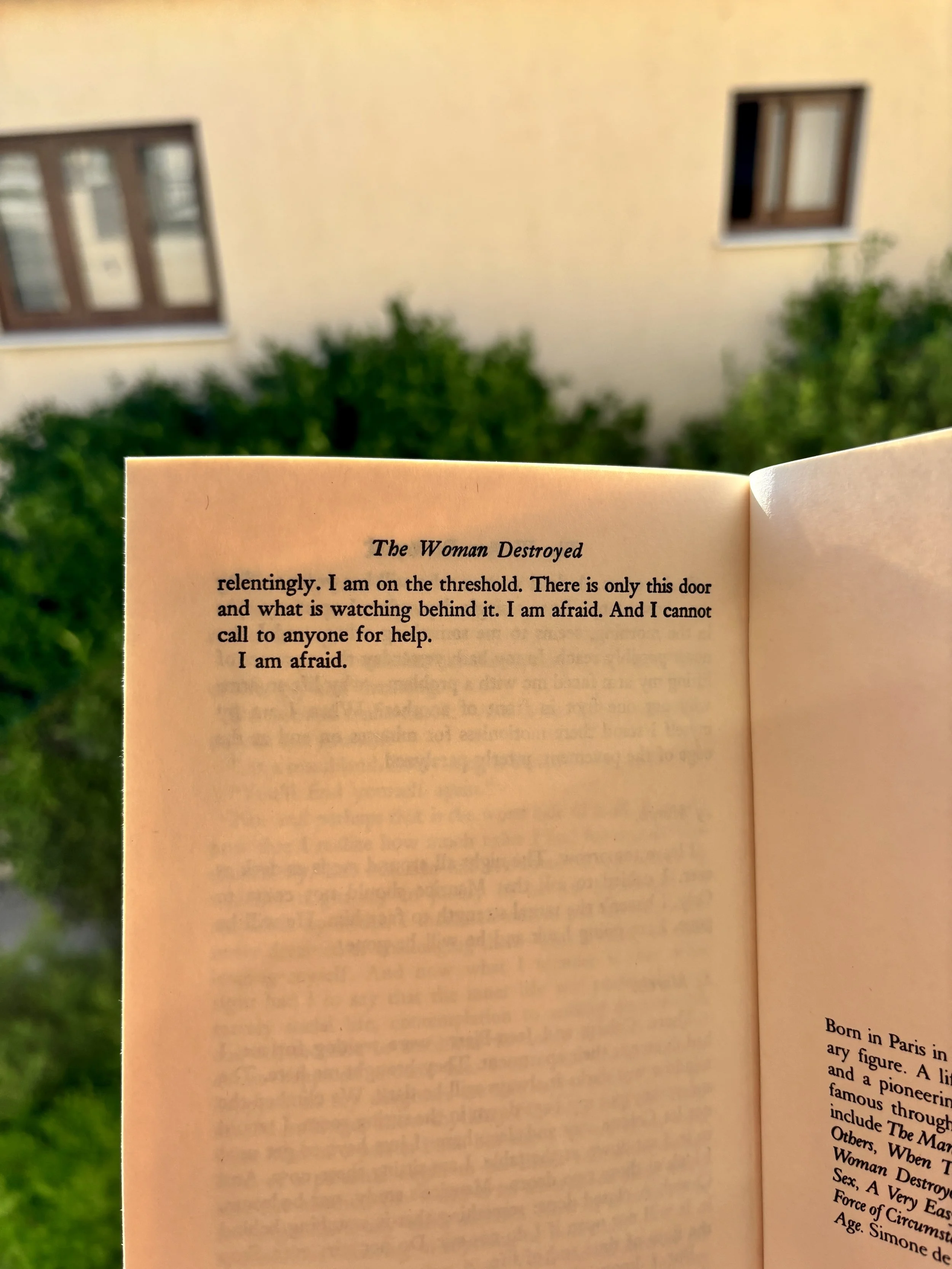
And then, as part of my summer reading list, I read Simone de Beauvoir's The Woman Destroyed. A friend bought it for me from New York in November, and only now did I have the chance to read it. As I was reading it, I kept thinking why did she bring this book to me?

I know now. I am not quite sure if she knew what the book explored, but the last text left me in pieces. I am not even sure it is Maurice leaving Monique that destroyed me, or the cheating itself. There is something else there. Something about having to look back at a life you thought was real and suddenly not knowing what was real anymore.
There is an easy thing to say about Monique, probably that she lost herself in a man. That she made Maurice her life. That she should have had her own things, her own work, her identity. We hear this all the time as women. Be independent. Have your own life. Never depend too much on a man. Never lose yourself. Agreed. Of course. But was it that that destroyed her?
It wasnt - for sure - that she didnt have a self outside Maurice. It was that she built a life around a life that she thought was real. And what do you do when suddenly someone makes you question the reality you have been living in? You start going backwards. You start spiralling. When did this happen? Was he already thinking about her then? Was that moment real? Was I the only one who thought we were happy? When he said that, did he mean it? How long was I living in one version of our life while he was living in another? I think there is something particularly cruel about that, and I am sure, or I think, that many women know it.
I have been thinking about how many times we have been part of these triangles in one way or another. Relationships, friendships, even jobs. How many times someone else had the power to give and remove attention, affection, recognition, desire, and suddenly we found ourselves looking at another woman and wondering what she had that we didnt.
Why her? What does she have? What did I do wrong? Was I not enough? I have done this. I think many of us have. And there is something so misogynistic in the structure of this.
I remember once telling a male friend that I thought there was something misogynistic about the way men cheat. He said, women cheat too. Yes, obviously women cheat too. But that wasntt what I meant, and I couldntt articulate it properly at the time. Maybe I still cant. Certainly, I dontt mean that every man who cheats hates women. I dont mean that women are somehow morally superior. People lie. People betray each other. People want other people. People change their minds. Maybe people are just like this sometimes.
But there is something about the way male desire has been allowed to exist in the world that I keep thinking about. The I couldn't help it. The I wanted her. The I have feelings for both of you. The I still love you, but...The YOU made me do it.
As if desire happens to him and then everyone around him has to rearrange themselves because of it. I know this because I have been asked to do it. We were all asked to do it, one point or another. I was told he couldntt help it. I was told it would be rectified. And somehow I was supposed to wait while he figured himself out. His confusion became something I had to live inside. Perhaps this is why Maurice made me so angry. He moves between Noëllie and Monique while both women are left responding to him. His desire moves. Their lives move around it.
There is something so telling about that because, of course, you cannot always control desire. You can meet someone and want them. You can fall out of love. You can fall in love. You can wake up one morning and realise that you dontt want the life you thought you wanted. Nonetheless, I cannot help what I feel is not the same as I cannot help what I do. Somewhere between desire and action there has to be responsibility. Accountability, even.
Even so, women have so often been asked to understand male desire as though it were some uncontrollable force of nature. He couldnt help himself. He was unhappy. He needed something else. He fell in love. He needed to feel alive again. Fine. But what happens to the person standing on the other side of all that aliveness? What happens to the person left in pieces? Then there is the other woman.
This part of Beauvoir is horrible because Monique becomes obsessed with Noëllie. What does she have? What does Maurice see in her? She becomes everything Monique thinks she isn't. Isn't this something women know too well? Another woman appears and suddenly we inspect her. Her body. Her age. Her work. Her sexuality. Her confidence. Her face. The way she speaks. The way she dresses. We look at her and then we look at ourselves, as if she contains the answer, as if another woman's desirability explains our pain, and meanwhile, the man who created the triangle somehow remains at its centre.
Maybe that is one of patriarchy's greatest successes. Making women look sideways at each other instead of looking at the structure that placed them there. Is this the case only in relationships?
At times I remember that I have seen versions of it in workplaces. In friendships. In art. Someone decides who gets attention, who gets invited, who gets taken seriously, who gets seen. And suddenly everyone underneath that structure starts competing with one another instead of asking who has been given the power to decide our value in the first place. Maybe that is why The Woman Destroyed hurt me so much. I couldnt sleep the night after finishing the book. I was decoding. All night long. I thought, okay, this isnt only about a husband cheating on his wife. It is about what happens when another person's desire becomes powerful enough to make you question yourself.
And then we tell ourselves, don't let it. Our mothers insist. Our friends shout. Know your worth. Be independent. Move on. Choose yourself. I understand these phrases. I have probably said them myself. Sometimes they make me angry too. Because what does independence have to do with being hurt by someone you trusted? You can have your own money. Your own career. Your own friends. Your own body. Your own ideas. You can know perfectly well who you are, and someone can still break your heart. Someone can still make you question what you thought you knew.
Otherwise, what are we asking women to become? So independent that nobody can touch us? So self-contained that losing someone means nothing? I dontt want that either. I never thought that the answer is to never build a life around another person.
Maybe the answer is to understand that when we love someone, we do build something around them. Of course we do. We make routines. Memories. Private languages. Stupid jokes. Beds. Houses. Trips. Sunday mornings. Versions of ourselves that only existed because that person was there to witness them. We make a world. What destroys Monique is not that she made that world, it is that she thought they were making the same one. That is the part I cantt stop thinking about. Maybe sometimes the life was real. Maybe the love was real. Maybe nobody was lying in the beginning. Maybe two people really did inhabit the same world for a while. And then one person quietly left it before the other one knew they were gone.
What do you do with that? I dont know. The ending frightened me so much. Monique and that door. I swear I saw the door myself. The life behind her has collapsed and she has no idea what exists in front of her. I think many of us have stood in front of that door in one form or another. Maybe the point isntt to become women who cannot be destroyed. It is impossible to love like that anyway. Maybe it is to love, to give, to build the world with someone, but to somehow keep something that remains ours. Not because everyone will betray us, because nobody else should ever be the only person who gets to tell us whether the life we lived was real.
And then I thought about Beauvoir herself. About immanence and transcendence. I kept coming back to it after finishing the book because maybe Monique's destruction is also there. Beauvoir writes in the Second Sex about the way women have historically been pushed towards immanence. Towards repetition. Maintenance. The home. The everyday. Towards keeping things going. Towards becoming the person who holds a life together while somebody else gets to move beyond it. Men, historically at least, have been granted transcendence. The possibility of projects. Movement. Becoming. Going somewhere else. Wanting something else. Reinventing themselves. Suddenly Maurice made even more sense to me. He gets to move. He gets to desire something different. To become someone different. To imagine another life. To pursue another woman. His dissatisfaction becomes movement. His desire takes him somewhere.
Monique? She has been maintaining the world he is now able to leave. There is something almost unquestionably cruel about that. The home, the marriage, the children, the memories, the routines, everything she has spent years sustaining, are suddenly treated as evidence that she failed to have enough of a life of her own. As if all that work was nothing. As if maintaining a shared world was not also a project. As if loving people, raising children, remembering birthdays, making dinners, keeping friendships alive, carrying the emotional history of a family, making a home feel like a home, did not require a self.
This is exactly the trap. If one person's transcendence depends upon another person's immanence, then somebody gets to become while somebody else is asked to remain. Rhis is what bothers me about the way we speak about independence too. We tell women to transcend. Build the career. Have the money. Travel. Desire. Become. Never stay still for anybody. And yes, I want all of that. I want women to move. Still, I dont want liberation to mean that we have to become incapable of staying, caring, building, depending, loving. I dont want transcendence to become another demand placed upon women. Another way of saying: you should have protected yourself better. The problem was never that Monique stayed. The problem was that Maurice was allowed to experience himself as the person who could always leave, and that changes the door for me.
At the end, Monique is terrified of it. The door is closed and somewhere beyond it there is a life she cannot yet imagine. I saw only destruction there. Now I wonder whether the door is also the first terrifying possibility of transcendence. Not the stupid version of empowerment where she closes the door on Maurice, puts on lipstick, finds herself and everything is suddenly fine. No. She is destroyed. She doesnt know who she is yet. Transcendence begins exactly there. Not in knowing what comes next, but in understanding that something can come next. That she is still capable of becoming. This is what I want to keep from this book. Not that women should never build their lives with other people, or that we should never depend, or that we should love less so that losing someone hurts less. But that love should never require one person to remain immanent so that the other can transcend.
We should both be allowed to move. We should both be allowed to change. We should both be allowed to desire. We should both be responsible for what we do with that desire. And we should both be allowed to become. Maybe that is what is behind the door. I dont know. Even so, perhaps, eventually, she opens it.
A final note, maybe to myself. I have always been slightly sceptical of dwelling too much on the feminism that became foundational to the second wave. It is because I thought we had moved beyond some of it. I thought the language of woman as Other, immanence, dependence, domesticity, the male subject and the female object belonged to another moment. Important, obviously, but historical. Something to understand and then move on from. I think I was a little too confident about the moving on part. However, because reading Beauvoir now, I kept recognising things. Not everything. Of course not. Women's lives are not Beauvoir's women frozen in the 1940s or 1960s. We work. We leave. We earn money. We decide not to marry. We decide not to have children. We build careers, travel alone, live alone, make things, become things. The female experience has changed enormously, and feminism itself has complicated the category of "woman" far beyond the world Beauvoir was writing from. However, there are moments when something very old seems to sit underneath something oddly contemporary.
The woman waiting while the man decides. The woman being told to understand his desire. The woman comparing herself to another woman. The woman carrying the emotional consequences of somebody else's freedom. The woman being told afterwards that she should have known her worth. For sure, I now know that patriarchy doesntt always survive by keeping women in exactly the same place. Maybe it survives by changing shape. You can be financially independent and still find yourself waiting for someone to choose you. You can have a career and still measure yourself against another woman's desirability. You can understand every feminist argument about autonomy and still be completely shattered when someone you trusted changes the reality you thought you shared.
We transcend in some parts of our lives and remain caught in immanence in others.. this is what surprised me most about returning to Beauvoir. I thought I was reading something I had, politically and intellectually, already moved beyond. Instead, occasionally, annoyingly, painfully, I recognised the room. I recognised the triangle, the woman standing in front of the door.
But I can still think that Beauvoir doesnt explain the female experience today. There is no singular female experience anyway. Nonetheless, some structures she was trying to name never disappeared completely. They just learned how to live with us becoming freer.