What Happens When the Cage Is All We Know? ///
I do not intend for this blog to become something I have to constantly feed. I do not know how regularly I will write here, or even exactly what form it will take. What I do know is that I have gathered a large amount of writing over the years (about art, politics, gender, performance, books, and the things that sit somewhere between them) and lately I have found myself wanting to write more and more.
Perhaps this blog is a room of my own. One doesn't have to read it for it to exist. I think of it, in some ways, as a journal, or perhaps a journey.
A space for thoughts that begin somewhere else. In something I read, something I see, a conversation, an artwork, a political moment, or an idea that stays with me. Not necessarily reviews, and certainly not definitive readings. I am no expert. They are more like encounters, or moments when something makes me stop and reconsider a question I thought I understood.
Jacqueline Harpman's I Who Have Never Known Men was my most recent encounter.
I finished it with considerably more questions than answers. I suspect that is how the book wants to leave us. I will not give away its story here because its uncertainty needs to be experienced. What stayed with me was its dystopian world, the profound loneliness at its centre and, above all, its helplessness. Or maybe, the politics of that helplessness.
We often imagine freedom through the structure of captivity. We identify what confines us and assume that liberation begins when we escape it. A few days before reading Harpman, I had finished Rousseau's Reveries of the Solitary Walker, and I kept returning to his understanding of freedom that did not include the abundance of choices, but the understanding that one should no longer be compelled to do what one does not want to do. There is something reassuring about such a formulation. Identify the constraint, remove it, and freedom appears on the other side.
Find the cage. Name the cage. Question the cage. Break the cage.
But, when I finished Harpman's novel, it made me wonder whether that is enough. It made me question so many things, one being... What happens when the cage is the only structure we have ever known?
The novel kept returning me to patriarchy. Certainly, to domination by men, but also to patriarchy as a structure through which identities, relationships, desires, bodies and possibilities become intelligible. The presence of men as a spectre in the novel is inseparable from systems of authority, surveillance and dependence. But it was not the spectre that kept haunting me; it was the system of power that their presence made visible. Perhaps it was knowing that structures do not necessarily disappear when their most visible agents do.
This is where my own reading became more complicated. It would be too easy to construct the novel around a sequence in which patriarchy is the cage, men disappear, and the women are subsequently faced with the task of learning how to be free. If patriarchy is structural, its norms can survive the physical absence of men. The older women carry with them memories of heterosexuality, family, gender roles, sexuality and social expectations. They carry a knowledge of what a life was supposed to look like, making the cage, in other words, not only material.
We can leave the structures of confinement while continuing to carry some of its architecture within us. It is one thing to recognise the conditions of our confinement. It is another to imagine a world for which we have no map.
Perhaps this is why a novel first published in 1995 felt so relevant and contemporary to me. We seem to inhabit a moment of extraordinary awareness and simultaneous disorientation. A kind of not knowing. We have become increasingly capable of naming the systems that have shaped us. Patriarchy, institutional power, inherited gender roles, social hierarchies. Yet naming a structure does not automatically produce an alternative to it.
We know increasingly well what we are resisting. I am less certain that we know where we are going. I certainly dont.
The protagonist complicates this further because she does not relate to patriarchy in quite the same way as the other women. To say that she has been “formed under patriarchy” would not be entirely accurate. She has been subjected to a gendered regime of domination. She knows surveillance, prohibition, discipline and control. But she has not undergone many of the ordinary processes through which womanhood is socially constructed. She does not know herself through relationships with men, through heterosexual desire, marriage, motherhood or many of the expectations that shaped the identities and memories of the other women. She knows patriarchal power as prohibition and surveillance, but not fully as socialisation.
This makes her position extraordinarily peculiar. She is neither inside nor outside the structure. She has been subjected to its violence without fully inhabiting the social identity it might otherwise have produced for her. And this is where her persistent need to learn became so important to me.
She observes. She reads. She calculates. She questions. She teaches herself about a world that has given her almost nothing with which to understand it. At first, I wanted to read this as liberation when one is being deprived of the structures that once determined existence, and in that way, she educates herself into freedom. But I think that resolves Harpman's problem too easily. Or simplistically.
Knowledge does not make her free. It does not reveal the truth of her circumstances, undo what has happened to her, or provide her with a coherent alternative world. She continues to exist within conditions she did not choose and cannot fully understand. What learning gives her is something more modest, but perhaps more politically significant. It gives her agency within conditions she cannot control.
Her education becomes a practice. Reading, observing, understanding, questioning, ways of refusing complete passivity before a world that remains largely unknowable to her. Education becomes a way of establishing a relationship with the world when no inherited structure can adequately explain that world to her.
And just like that, I find myself spiralling back to the title: I Who Have Never Known Men. But, what does it actually mean to have never “known” men?
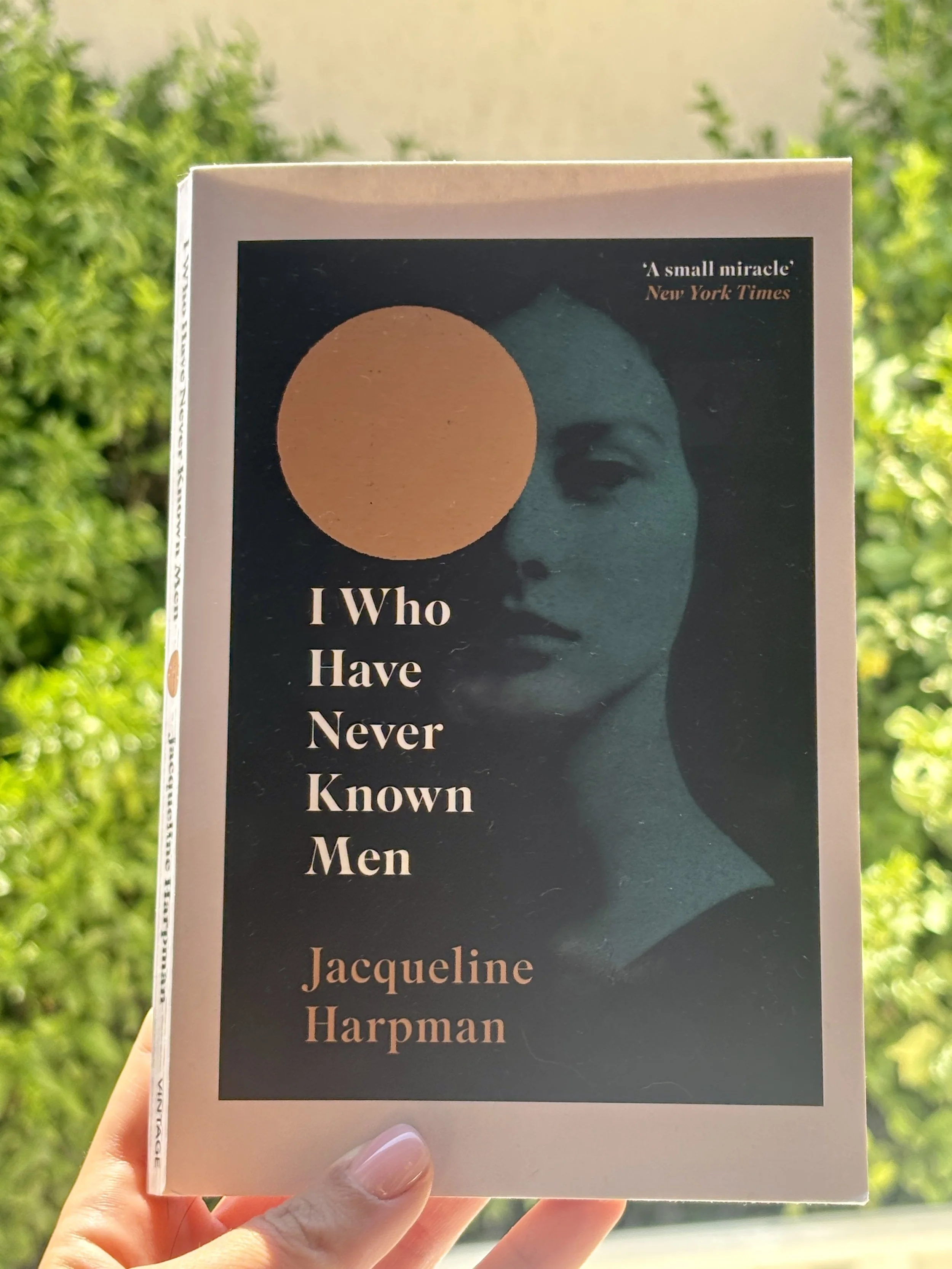
By the end, I am not sure that men are the problem in any straightforward sense. Men appear as agents of authority, but patriarchy exceeds the individual men through whom it operates. It is a structure that determines who knows, who watches, who commands, who depends, but also what kinds of relationships and lives become imaginable in the first place. The narrator may never have known men, but she has certainly known power and the elimination of one's identity.
The distinction between those two things is precisely what makes the title so disturbing to me.
The disappearance of men at some point in the novel does not lead to the disappearance of patriarchal structures, just as the disappearance of confinement does not automatically produce freedom. The older women continue to carry a vanished social world within them. The protagonist, meanwhile, has been denied much of that social world altogether. Neither position offers an uncomplicated route towards liberation.
Perhaps, then, I Who Have Never Known Men is not really about what happens after the cage opens. It is about something much more difficult, how one acts when the structure that once organised existence no longer provides a map, while its traces remain.
The novel refuses the reassuring sequence in which we identify oppression, dismantle it and emerge on the other side as liberated subjects. Freedom may not be something waiting for us outside the cage. Maybe freedom, as served to us, has never been an end-point to which we can just arrive. Perhaps it begins much more tentatively, in the capacity to question, to learn, to act within conditions we did not choose, and eventually to imagine possibilities for which we have inherited no map.
An end note, perhaps.
I also cannot leave this without thinking about the women who have historically been placed outside the boundaries of what is considered reasonable, intelligible, or acceptable. Women called hysterical, unstable, difficult, irrational, mad, too emotional, too angry, too much. There is a long history of turning a woman's refusal to inhabit the world as it has been prescribed to her into evidence that something is wrong with her, instead of asking what might be wrong with the world she is being asked to inhabit.
Maybe this is another reason Harpman's protagonist stays with me. I, was once, her. She has almost none of the coordinates through which a woman is conventionally made legible, and yet she persists in making sense of herself without them. There is something radical in that.
So, this is also for the women who have been made to feel unintelligible because they could not, or would not, inhabit the identities available to them. For those who were called crazy when they questioned the architecture around them. For those still learning that not fitting comfortably inside the structure does not necessarily mean that they were the ones who needed fixing.
Sometimes, perhaps, it is the very structure of existing under someone else's conditions that needs to be questioned.